
Garage-Door Repair Pages: The Highest-Intent, Lowest-Content Vertical in Home Services
Garage door repair is one of the strangest small markets in home services. The search behavior is purely transactional, the ticket sizes are reasonable, the buying decision often happens fast, sometimes while the customer's car is trapped inside the garage, and the websites in the category are almost universally terrible. In the garage-door sites I review, the pattern is usually the same: urgent searches, weak pages, and too many sites that make the phone number harder to find than it should be. Which means the market is wide open for the operator who treats their website like the actual asset it should be.
This is a vertical where high search intent meets low content depth. Almost every search is an emergency or near-emergency (the door won't open, the spring broke, the opener died, the car is stuck inside or outside). The customer doesn't shop in any meaningful sense. They tap the first credible result, get a same-day quote, and book. The differentiator on the website is being credible, fast, and easy to call. The category is so under-served that even modest investments in site quality produce outsized results.
Here's what I'd build for a garage-door repair site in 2026. It's the highest-intent, lowest-content vertical in home services. The operator who fixes that gap on their own site wins disproportionately.
The defining behavior: short decision cycle, high urgency
Garage-door search is unusual in its compression. The customer goes from "problem detected" to "service booked" faster than almost any home-services category. The dominant search patterns:
- Broken-spring emergency. "Garage door won't open," "broken torsion spring," "garage door spring repair." The customer's car is usually trapped. Decision happens fast.
- Opener failure. "Garage door opener not working," "LiftMaster repair," "garage door remote not working." Slightly less urgent but same-day intent.
- Off-track or damage. "Garage door off track," "garage door cable repair," "bent garage door panel." Visible physical problem, customer wants someone out today.
- Planned replacement. "New garage door installation," "garage door replacement cost," "insulated garage door." Longer decision cycle, higher ticket, more shopping.
Emergency work gets the first screen. Replacement work still needs real pages, because those jobs are bigger and people shop harder.
What goes above the fold
The garage-door homepage hero needs exactly four things, all visible without scrolling on mobile:
- Sticky phone number banner at the top. Big, tappable, persistent on scroll. The single most important element on the entire site for this vertical.
- H1 that names the service and the city. "Garage Door Repair in [City]" or "24/7 Garage Door Service in [City]" beats "Your Trusted Local Garage Door Experts" by an enormous margin.
- Same-day service messaging. "Same-day service. Most repairs completed in one visit." This is the conversion lever in this vertical. Customers calling at 8am want their car out of the garage by lunch.
- Inline lead form with three fields. Name, phone, ZIP. Optional one-line description of the problem. Form submission triggers an immediate call back, not an email response.
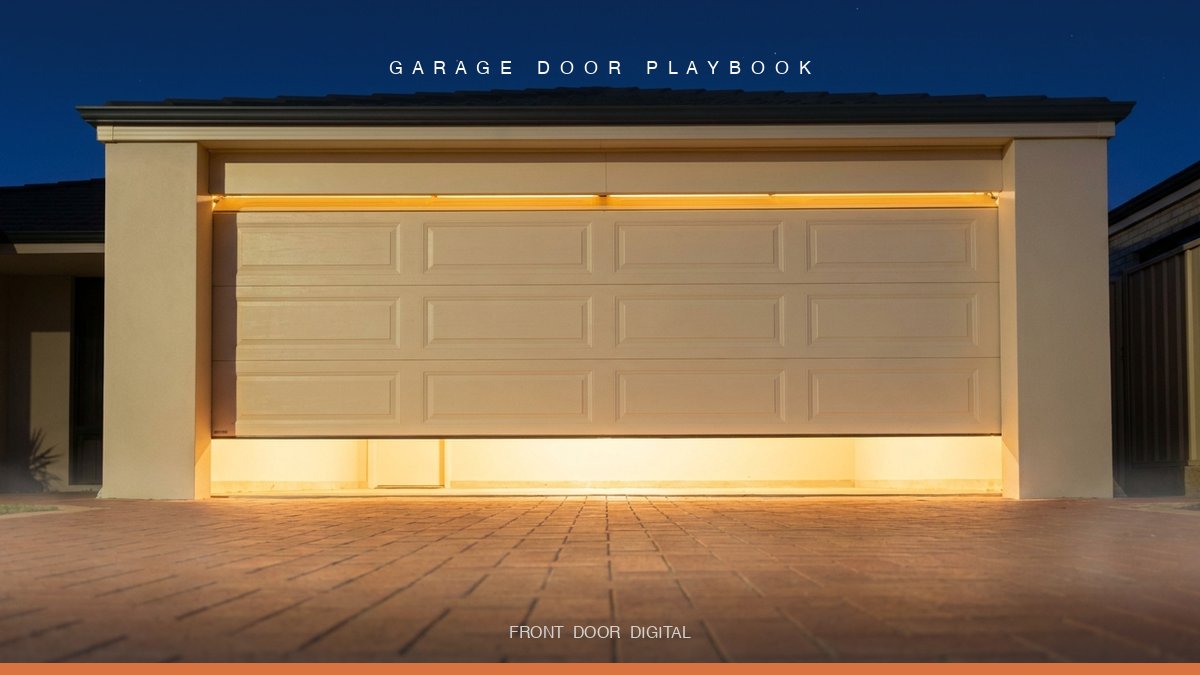
The hero image should be a photo of an actual technician at an actual garage door, ideally local. Stock images of perfect suburban homes with perfect garage doors read as templated and erode the local-trust signal.
The service page set
Garage-door service pages should map directly to what customers search for, which is more granular than most operators realize. I'd start with these pages:
- Garage door spring repair. Usually one of the highest-intent garage-door queries. Torsion springs, extension springs, broken spring replacement.
- Garage door opener repair. Common brands (LiftMaster, Chamberlain, Genie, Craftsman), troubleshooting, replacement options.
- Garage door cable repair. Off-track doors, cable replacement, drum replacement.
- Garage door panel replacement. Damaged panel replacement, color matching, structural repair.
- Garage door installation. New door installation, full replacement, insulated vs non-insulated.
- Garage door opener installation. New opener installation, smart opener integration, belt vs chain drive.
- Garage door off-track repair. Common emergency, distinct search query, distinct page.
- Commercial garage door service. Roll-up doors, sectional doors, gate operators. Different customer behavior.
For a typical garage-door operator, that's 8 to 12 service pages. Most garage-door sites have one or two. The gap is the opportunity.
Trust signals specific to garage-door
Garage-door service has some category-specific trust dynamics worth understanding:
- License and insurance. Some states require contractor licenses for garage-door work, some don't. Either way, display whatever credentials you do have. Insurance and bonding documentation should be visible.
- Manufacturer authorization. If you're a LiftMaster Pro Dealer, an authorized service center for major opener brands, or a dealer for major door manufacturers, display those logos. They signal that you carry parts and have factory training.
- Same-day service language. "Most repairs same day" is a powerful differentiator. Back it up with plain scheduling. If you're at capacity, say so rather than over-promising.
- Real photos of trucks and technicians. The garage-door category has enough bait-and-switch operators that real photos matter. Photos of your real fleet, real techs in real uniforms, real local references all distinguish you from the bad actors.
- Up-front pricing on common services. "Most spring replacements: $250 to $450 depending on door size and spring configuration." Specific ranges build trust in a category where bait-and-switch pricing is common.
- Recent Google reviews. Pull live from your Google Business Profile. Garage-door is a category where reviews matter heavily because the trust gap is real.
Want a free audit of your garage-door site against the local competition?
Front Door Digital runs free site evaluations for garage-door operators. We benchmark your site speed, conversion stack, and local SEO against whoever's currently outranking you. Get the audit.
The bait-and-switch problem and why honest pricing wins
One specific dynamic worth addressing: garage-door is a category notorious for predatory pricing tactics. The bad actors quote a $19 service call, send a tech who diagnoses "extensive damage," and presents a $1,800 quote to fix what often should have been a $250 spring replacement. Customers who've been burned by this once carry that suspicion into their next search.
The operator who differentiates on transparent pricing wins disproportionately in this category. Specific ways to position around this:
- A pricing page with real ranges for the most common services. Not exact numbers, but ranges that show good-faith transparency.
- An explicit "no surprise pricing" guarantee on the homepage and service pages. "We quote the work before we start it. If the price changes mid-job, we get your approval first."
- A "what we charge for a service call" section that explains the diagnostic fee clearly and how it credits toward repair if you proceed.
- Customer reviews specifically referencing fair pricing. Solicit and surface reviews that talk about how the final bill matched the initial quote.
This costs almost nothing to add and can make the phone call easier to close with customers who've researched garage-door repair before calling. Which is most of them.
Service-area pages for garage-door
Garage-door service areas are usually tighter than big-ticket replacement categories because drive time eats into same-day repair capacity, but the competition is fragmented. Each city in your service area benefits from a dedicated page with the standard structure: H1 with service and city, 200 to 400 words of city-specific content, real local references, full conversion stack.
For garage-door specifically, the city pages should emphasize the same-day service commitment and the response-time messaging. "We service [City] with same-day appointments when the schedule allows." Local specificity compounds with the urgency messaging.
Frequently asked questions
Most of my business comes from Google Local Service Ads (LSAs). Do I still need a strong website?
Yes. LSAs and organic search do different jobs. LSA leads can get expensive. If you cite a range, tie it to your actual account data or a named source, and the cost-per-acquisition compounds across the year. Organic leads from a strong website are essentially free after the initial site investment. Use LSAs for urgent calls now. Use organic pages so you are not renting every lead forever.
What about the seasonal patterns in garage-door work?
Garage-door demand can be steadier than seasonal categories like HVAC or landscaping, especially for emergency repairs, because the failures (broken springs, dead openers) happen across the year regardless of season. There's some bump in cold-weather markets during the first few cold snaps (cold weather can expose worn springs faster) and some bump in spring (new-construction and replacement projects), but the seasonal swings are smaller than HVAC or landscaping.
Should I list specific brand expertise?
Yes. Customers often know what brand their opener or door is and search accordingly. "LiftMaster Repair in [City]" or "Genie Garage Door Opener Service" are real search queries with measurable volume. Build pages for the major brands you service. The pages don't need to be long, but their existence captures branded searches that generic pages won't.
How do I handle the 24/7 messaging if I don't actually answer overnight?
If you want to advertise 24/7, the call still has to get answered. An AI receptionist can cover after-hours calls without hiring an overnight dispatcher. Front Door Digital's AI Receptionist ($999 setup, $199/mo) picks up every after-hours call, captures the problem and the address, and books the same-day slot. If you'd rather not run 24/7 messaging at all, advertise "Same-day service available" and pair it with an SMS auto-reply for the off-hours calls. I broke down the full call-handling setup in the missed-call playbook.
Garage-door repair is the easiest home-services vertical to win on website quality alone, because the bar is so low. A clean, fast site with a visible phone number can beat older competitors that make emergency callers work too hard, simply because almost nobody else in the vertical takes their web presence seriously. The window is open. Most of your competitors won't notice.
Want to know how your site stacks up?
Get a free, no-pitch score on speed, SEO, and AI search. Takes about 90 seconds.